
Sediment Collection
Sediment samples were collected along designated transects (Figure 11), including stations located both outside and inside the breakwaters as well as onshore sites. A total of 18 samples were obtained, 9 offshore and 9 onshore, each consisting of approximately 250 g of surface sediment. Sampling was conducted during scuba dives for offshore stations and by hand for shoreline stations. After collection, all samples were labelled, placed into aluminium foil trays, and transferred to a drying oven set at 100 °C for 48 hours to remove all moisture prior to grain-size analysis.
Following drying, each sediment sample was processed using an Endecotts Octagon Digital Sieve Shaker. The shaker was fitted with a standard stack of six stainless-steel sieves with the following aperture sizes: 2 mm, 0.6 mm, 0.3 mm, 0.212 mm, 0.15 mm, and 0.075 mm, placed above the collection tin. Each sample was sieved for 10 minutes at amplitude setting 5, ensuring efficient separation of grain-size fractions. After sieving, the material retained on each sieve and in the pan was weighed individually to determine the mass percentage associated with each size class.
The percentage weight of each fraction was then entered into the GRADISTAT v.8 software package, which provides rapid computation of grain-size statistics based on the Folk and Ward (1957) graphical method as well as the method of moments. GRADISTAT constructs cumulative grain-size distributions in both metric (µm) and phi (ϕ) units, and applies linear interpolation to determine key percentiles (D10, D50, D90 and ϕ5, ϕ16, ϕ50, ϕ84, ϕ95), as described in Blott & Pye (2001) . Using these percentiles, the software calculates mean grain size, sorting, skewness, and kurtosis following the standard Folk & Ward formulae (1957) .
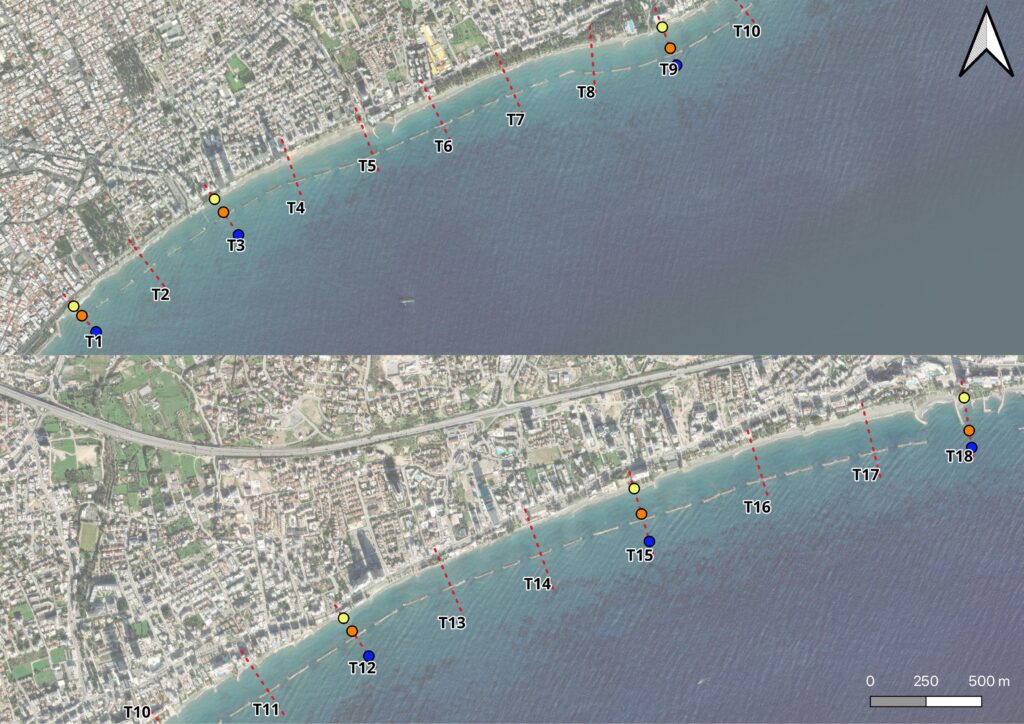
Figure 11: Sediment samples collected form selected profiles, with yellow points indicating sediments from the beach area, orange and blue points showing inside and outside the breakwater structures, respectively.
The D50 values reveal clear textural differences among the three sampling environments (Figure 12). Beach sediments and shallow underwater samples inside the breakwaters are dominated by fine to medium sand, with median grain sizes typically between 177 and 236 μm. In several transects (T3, T9, T15), the shallow inner‐breakwater samples are even slightly coarser than the corresponding beach sediments, indicating an energetic nearshore environment where wave and current action are sufficient to maintain relatively coarse sands on the seabed. In contrast, the deeper offshore stations outside the breakwaters are uniformly much finer, with D50 values clustering tightly around 90–96 μm, corresponding to very fine sand. This sharp textural break between the inner and outer environments suggests that the breakwaters and associated nearshore morphology favour the retention and reworking of coarser sands in the beach and shallow zone, while finer material preferentially accumulates in deeper water seaward of the structures.

Figure 12: Median grain size (D50, μm) for all sediment samples collected along transects. Each transect includes three sampling locations representing different energy environments, beach sediments (brown), shallow waters inside the breakwaters (light blue), and offshore sediments outside the breakwaters (dark blue).
The sediment composition across all stations reveals a clear gradient in depositional energy, with beaches characterised by predominantly sandy material, shallow underwater stations generally retaining sand-dominated textures with slight increases in finer fractions, and deeper offshore stations exhibiting the highest proportions of mud (Figure 13). This progression indicates that coarser particles are concentrated in the more energetic beach and nearshore zones, while finer sediments preferentially accumulate in deeper, lower-energy waters beyond the breakwaters.

Figure 13: Composition of sediment types across all transects. For each transect, the three bars represent (1) beach sediment, (2) shallow underwater sediment inside the breakwater, and (3) deeper underwater sediment outside the breakwater.